Eli, Eli, lama sabacthani?


MATCHES (by Robert Nye)
Some matchsticks in a patch of melting tar
Held my attention for at least an hour
One afternoon when I was rising four.
Crouched in the shadow of some willow trees
I stared at them and saw the way love sees,
And all was close and clear and singular.
Three matchsticks in a black hot patch of tar,
One spent, one bent, one still a fusilier
Standing up proud and perpendicular
With fire in his head, my cavalier.
Well, I knelt by them on my naked knees,
Transfixed as always by simplicities.
I loved those lordlings of the molten square,
My puny masters stuck in hot black tar,
Though only now I’ve worked the reason out
(If love needs reasons, which of course I doubt):
We’re outcast in this world, and derelict,
Matches from nothing into nowhere flicked.
Praying Drunk
Our Father who art in heaven, I am drunk.Again. Red wine. For which I offer thanks.I ought to start with praise, but praisecomes hard to me. I stutter. Did I tell youabout the woman whom I taught, in bed,this prayer? It starts with praise; the simple formkeeps things in order. I hear from her sometimes.Do you? And after love, when I was hungry,I said, Make me something to eat. She yelled,Poof! You’re a casserole!—and laughed so hardshe fell out of the bed. Take care of her.
Next, confession—the dreary part. At nightdeer drift from the dark woods and eat my garden.They’re like enormous rats on stilts except,of course, they’re beautiful. But why? What makesthem beautiful? I haven’t shot one yet.I might. When I was twelve, I’d ride my bikeout to the dump and shoot the rats. It’s hardto kill your rats, our Father. You have to usea hollow point and hit them solidly.A leg is not enough. The rat won’t pause.Yeep! Yeep! it screams, and scrabbles, three-legged, backinto the trash, and I would feel a little badto kill something that wants to livemore savagely than I do, even ifit’s just a rat. My garden’s vanishing.Perhaps I’ll merely plant more beans, though thatmight mean more beautiful and hungry deer.Who knows?I’m sorry for the times I’ve drivenhome past a black, enormous, twilight ridge.Crested with mist, it looked like a giant waveabout to break and sweep across the valley,and in my loneliness and fear I’ve thought,O let it come and wash the whole world clean.Forgive me. This is my favorite sin: despair—whose love I celebrate with wine and prayer.
Our Father, thank you for all the birds and trees,that nature stuff. I’m grateful for good health,food, air, some laughs, and all the other thingsI’m grateful that I’ve never had to dowithout. I have confused myself. I’m gladthere’s not a rattrap large enough for deer.While at the zoo last week, I sat and weptwhen I saw one elephant insert his trunkinto another’s ass, pull out a lump,and whip it back and forth impatientlyto free the goodies hidden in the lump.I could have let it mean most anything,but I was stunned again at just how littlewe ask for in our lives. Don’t look! Don’t look!Two young nuns tried to herd their gigglingschoolkids away. Line up, they called. Let’s goand watch the monkeys in the monkey house.I laughed, and got a dirty look. Dear Lord,we lurch from metaphor to metaphor,which is—let it be so—a form of praying.
I’m usually asleep by now—the timefor supplication. Requests. As if I’d stayedup late and called the radio and askedthey play a sentimental song. Embarrassed.I want a lot of money and a woman.And, also, I want vanishing cream. You know—a character like Popeye rubs it onand disappears. Although you see right through him,he’s there. He chuckles, stumbles into things,and smoke that’s clearly visible escapesfrom his invisible pipe. It makes me think,sometimes, of you. What makes me think of meis the poor jerk who wanders out on airand then looks down. Below his feet, he seeseternity, and suddenly his shoesno longer work on nothingness, and downhe goes. As I fall past, remember me.
Between the witching hour and its successor,
I caught her with my utility knife in the open closet,

drawing a dark rill of blood from her forearm;
I watched unsure of what to say or do, frozen,

more or less, in the mountain of air separating us.
Wise words slipped from my mouth like indigo birds

into the caries-colored early evening, supported by
nothing I could draw on from reality. In the end,

this poem will rise and fall on the relative success
of what I should have said, known, thought, or taught.

Before. Instead things fall apart as I grasp her
by the forearm, press the brachial artery and try

to ignore her pleading, I just want to die, then Daddy,
then Daddy again. When all the bad things happen

in the world, someone told me once, God's heart is the first
to crack, but no one, no thing breaks our silent lock.

I hold her in my arms; my hand fills with her blood.
Her pale face a giant tear. Her blood sauna-warm.

I wish I could say something shifted in me too.
But I just wanted my daughter to be well enough

to someday peek at me over the edge of a book
and smile.
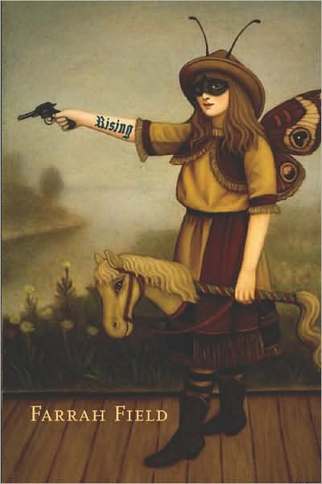
With the rise of the literary memoir in major publishing houses, it is worth remembering that through the second half of the 20th century until very recently, the memoir was the province of verse. Farrah Field’s Rising has a pervasive energy to get down an account, avoiding the narrative-suspicious modes of Language Poetry and other narrative-resistant forms, while at the same time, digesting the devices of these schools to create poems that lean dynamically against each other. Narrative in contemporary poetry, generally, has to be able to dance more quickly through points of view, voice, and time, as well as through description and reflection. Since the memoir has taken over the first-person singular, the Frostian, "I did something, I learned a lesson” mode comes across as sort of stodgy to all except those who love parables. Instead of an amiable stroll in which we can vaguely see what is ahead of us, Field's poems pack a chapter of details into a handful of incisive lines that sweeps the reader to conclusions one is often not prepared for.
Field has the journalist’s eye and ear for detail and the novelist’s sense of tactile invention. The locations and acquired dialects are primarily (but not entirely) southern:
Snakes hang like fingers in branches,
claw through humidity, then S away.
The flashiest metaphor is the final one, a perfect merging of the visual aspect of the metaphor (the “S” you see on the page) with the imaginative (the snake “S’ing” in the scene). But note also the individual snakes hanging together in the air, making a hand through its climate. The two lines concisely evoke the atmosphere of “In Lecompte Bayou,” exceeding only by a syllable an evocative haiku unto itself. More here.
Here's another take, from John Cotter at Open Letters Monthly.
I am part of them like fire insurance and quick
look to the left--kinfolk stare at me by way of cuticles.
Rising, Farrah Field’s first collection, is set in the Deep South and is canny about the deep-southern landscape that popular culture (and William Faulkner, and CD Wright) has made. Poems with titles like, “Self-Portrait in Toad-Suck, Arkansas,” and “Voodoo,” and “Possums and Critters Gets Back There,” set a gothic mood: mud, rot, sex (“If you fuck someone else, I’ll feel it on you”), and superstition. Whereas the first page of Harmon’s book says “Whither,” the first poem in Field’s uses “wither.” In as many poems the speaker falls into a muddy hole, thinks on the drowning of New Orleans, watches the barn where she used to have sex get torn down, and mixes “bleach to clean up the maggots.” More here.
I’d like to say I left New York and never looked back, that there was some cloud-parting moment of clarity when I knew I had to stop being a New Yorker, stopped claiming the appellation of New York Poet, and never looked back. But I can’t.
My life as a New York Poet begins at age 26, in seminar rooms near Washington Square, reciting first drafts with sober incantation. Star Teacher #1 orders us to read Poet in New York. I do. “New York has given me the knock-out punch,” Federico García Lorca writes back to his family in Spain in 1929. I share classes with a Troubled South African Poet of Indian Descent, who ululates and laments the absence of servants in her West Village apartment. She brings in handwritten poems, calls her classmates racists. Finally, one night, Star Teacher #1 tells her this is all inappropriate, calls her into her office. We never see her again. Two years later, another student asks Star Teacher #2 what to do when we get out of grad school: Should we apply for teaching jobs, send poems to journals? Her tone is desperate; she really wants to know. Star Teacher #2 pauses, looks at the ceiling—dreaming of his summer house in Vermont, no doubt.
“Try just being a poet,” he says.
People write this down.
My life as New York Poet ends 12 years later, on March 12, 2005, when I announce my intention to move out of town—upstate to a teaching job, the coveted prize for poets—to 312 people on my personal email list. No one responds to this email. From then, it takes all of six months to lose almost 100 poet friends. “Before the late 1960s,” Norman Podhoretz writes in his book Ex-Friends, “I was much better at making friends of strangers than of making enemies of friends.” Podhoretz’s ex-friends—Allen Ginsberg, Norman Mailer, the Trillings—were part of his Family of New York, fellow travelers in the writing scenes of his time. Some of my ex-friends are now successful, some may become famous. By March 2005, after 12 years in New York, it seemed I was much better at making enemies of friends than friends of enemies.
Blood Blossoms What kind of blooms are these which linger into early winter survive so many nights of freezing temperature still thriving in...


