First one in some time. It won't last long, so get it while you can.
*poof*
Thursday, December 31, 2009


Monday, December 21, 2009
Limberlost Press
I have this bad habit, you see. I don't read books inasmuch as I read authors. Once I get my hooks into something good, I want it all. Which leads one to unfortunate (but lucky) circumstances like owning everything Peter Matthiessen ever put to paper, an ouevre which will give me lasting pleasure into my dotage, or owning all the volumes in the Poems of the Millenium series. I despair even of completing all the books in my library, let alone the 5 or 6 or 20 new ones I pick up every month. I tell myself I have no other public vices, and I purchase at will.

So, recently, in my desire to buy all the Ed Dorn I could get into my system, I picked up his last book, Chemo Sabe--from Limberlost Press--a beautiful oversize chapbook of poems written as Dorn was dying of cancer. Light holiday reading in other words. The papers on this book are exquisite, the type is large enough to read comfortably--not always the case--and it's generally a fine product before you even get to the words.
I just bought my second chap from them, Beneath the Chickenshit Mormon Sun, by Bruce Embree, who I'd not heard of. How can you resist that title, though? Between that and the bright yellow-orange color, I was sold. I'm simple that way.
The man himself is another sad casualty--the suicidal poet. No need to say more of that. There is more to him, of course. The words. His style is plain, with nothing you would consider experimental or even contemporary, except for a curious habit of leaving the "I" out his persona's direct address, as you'll see in this poem. I say curious because that missing "I" seems to occur at random throughout the poems. The book lends itself to a staccato reading, the way you might read a bit of prose, and it's born of the Bukowski school. Except,with talent. But, see for yourself.

As always, I want to read more of this man, and there's only one chapbook left to find. And I'm on the hunt for it, knowing I have new books coming for Christmas, notwithstanding the fact that we just bought a house and despite the money I'm sure it will cost, I have to have it.
Sometimes, my vice is painful. But if it wasn't painful sometimes, it wouldn't be a vice.
And remember Limberlost Press. These are some of the most beautiful chapbooks I own, and I'll surely be combing through the catalogs to buy more. Check them out.
I just bought my second chap from them, Beneath the Chickenshit Mormon Sun, by Bruce Embree, who I'd not heard of. How can you resist that title, though? Between that and the bright yellow-orange color, I was sold. I'm simple that way.
The man himself is another sad casualty--the suicidal poet. No need to say more of that. There is more to him, of course. The words. His style is plain, with nothing you would consider experimental or even contemporary, except for a curious habit of leaving the "I" out his persona's direct address, as you'll see in this poem. I say curious because that missing "I" seems to occur at random throughout the poems. The book lends itself to a staccato reading, the way you might read a bit of prose, and it's born of the Bukowski school. Except,with talent. But, see for yourself.
Beneath the Chickenshit Mormon Sun
It turned out worse than I thought
The champion defended his title
then Eldridge Cleaver came on
to talk about his reason for becoming a member
of the Church of Jesus Christ of Latter Day Saints
Grandma and I damn near fell out of our chairs
Went to town and got crazy drunk
Came back home, called you long distance
after cruising and drooling Mainstreet again
This is my last wish and love poem
It is as follows
Want to hold the wake at noon with plenty of acid and rum
No friends or relatives
Ghost music by Hendrix and the Byrds
drowning all sound
as you fuck me to dust
beneath the chickenshit Mormon sun.
Sometimes, my vice is painful. But if it wasn't painful sometimes, it wouldn't be a vice.
And remember Limberlost Press. These are some of the most beautiful chapbooks I own, and I'll surely be combing through the catalogs to buy more. Check them out.
Sunday, December 13, 2009
Brian Trimboli: " THINGS MY SON SHOULD KNOW AFTER I’VE DIED"
THINGS MY SON SHOULD KNOW AFTER I’VE DIED
I was young once. I dug holes
near a canal and almost drowned.
I filled notebooks with words
as carefully as a hunter loads his shotgun.
I had a father also, and I came second to an addiction.
I spent a summer swallowing seeds
and nothing ever grew in my stomach.
Every woman I kissed,
I kissed as if I loved her.
My left and right hands were rivals.
After I hit puberty, I was kicked out of my parents’ house
at least twice a year. No matter when you receive this
there was music playing now.
Your grandfather isn’t
my father. I chose to do something with my life
that I knew I could fail at.
I spent my whole life walking
and hid such colorful wings.
near a canal and almost drowned.
I filled notebooks with words
as carefully as a hunter loads his shotgun.
I had a father also, and I came second to an addiction.
I spent a summer swallowing seeds
and nothing ever grew in my stomach.
Every woman I kissed,
I kissed as if I loved her.
My left and right hands were rivals.
After I hit puberty, I was kicked out of my parents’ house
at least twice a year. No matter when you receive this
there was music playing now.
Your grandfather isn’t
my father. I chose to do something with my life
that I knew I could fail at.
I spent my whole life walking
and hid such colorful wings.
Tuesday, December 8, 2009
Miklos Radnoti
Hi. I'm still alive. The kids and I are trading off the flu. But--and this is important--I found my Collected Paul Blackburn. And all my poetry books--72 linear feet--are shelved.

Via Silliman's blog, I'm reminded of one of the great and sad stories of poetry: Miklos Radnoti. The first few graphs of Camille Martin's loverly post are below.

Via Silliman's blog, I'm reminded of one of the great and sad stories of poetry: Miklos Radnoti. The first few graphs of Camille Martin's loverly post are below.
November 10 marked the sixty-fifth anniversary of the murder of Miklós Radnóti, a Jewish Hungarian poet killed by Hungarian Nazi collaborators during a three-month death march and buried in a mass grave. A year and a half later, when his wife, Fanny, located and exhumed his body, a notebook of his poems was found in his coat pocket. Radnóti had continued to write poetry during his internment in various work camps, his slave labour in a copper mine, and his forced march across his native Hungary, bearing witness to the horrors to which he ultimately succumbed.
As a tribute to him, I’m reproducing six of his poems below. The first is an eclogue, which is an ancient pastoral poem in the form of a dialogue between shepherds. Radnóti’s eclogue imagines a dialogue between an unlikely pair—a fighter pilot and a poet—that reveals his deep concern with human empathy.
Saturday, November 14, 2009
Poetry Criticism With Bill Knott

He doesn't avoid his feelings, which I respect.
I always wished there were people like him in my crit groups--people who just fucking said what they thought regardless of feelings. That's much easier to deal with, I think, than people who read and try to quietly kiss your ass with gentle words when they really hate your work. That's what criticism is for, pointing out the weaknesses. I admit I'm too nice most of the time, though somewhat less so these days, since I'm no longer teacher material--at least in a university. I think everybody is too nice.
Anyway--on to the criticism.
fugh
The Shampoo (From The Nightingales) by David Wojahn
How long it must have been, the girl’s hair,
cascading down her shoulders almost to her waist,
light brown and heavy as brocade: the story I’m
remembering of N’s, remembering as my own
hair’s washed and cut, the salt-and-pepper
cuneiform to frill my barber’s smock.
Arts and Science is expanding. The wall
to the empty shop next door pulled down
and a dozen workmen slink improbably
on scaffolds butting the dusty ceiling,
cacophony and plastic tarps, the whirr
of drills that mingles with the dryers’
jittery hums, the scissors’ flash,
veronicas of clicks, the coloring, the curling,
the antique cash register,
melodious with its chime. And best,
the liquid gurgle of hands massaging scalps
the row of sinks, twelve hands and six
wet scalps in a line. I’m next, and leaning back
(let me wash it in this big tin basin,
battered and shiny like the moon)
to the hiss of warm water cataracts
and Andrea’s long fingers. But I’m remembering
the girl in N’s story, the girl
she was at six. This is Birmingham,
1962, Rapunzel-tressed girl
whose parents are more glimpsed than known,
the Family Romance, mid-century American-
style, the child fetching ice
for the father’s drink, the far-off lovely
scent of mother’s perfume. More glimpsed
than known, separate phantom lights
edging from beneath closed doors
those nights she couldn’t sleep. Not the Birmingham
of sit-ins, the firehoses trained on
placard-waving crowds. But the Birmingham
of Saturdays when Anne-Marie would arrive
as always on the city bus by six,
before the parents’ cars would pull away.
Then the cleaning until noon, the cooking smells.
And then the big tin basin filled
at the backyard faucet by Anne-Marie,
the long brown fingers in the child’s hair,
the water sluicing, warm from the garden hose,
the soap suds almost flaring, the fingers
ten spokes over scalp and basin, their paths
through the hair and down the child’s back,
the synesthetic grace notes of the hands,
the stitchery, the trill, the body electric,
the fingertip pressure exquisite as it sings,
the braille of here and here and here.
David Wojahn, “The Shampoo (from ‘The Nightingales’)” from The Falling Hour. 1997.
*
Narrative poems like this one exasperate confuse and (increasingly) infuriate me.
First of all, what's Wojahn doing in this hair salon getting his hair shampooed, why doesn't he just shampoo it at home in the shower like most people? He seems to be a regular customer here, since he knows the hairstylist by name (line 23) . . .
In other words, he's doing something most of us don't do, and in reality
most people can't afford to have their hair shampooed at a salon,
he's doing something unusual but he doesn't acknowlege that fact, nor does he offer any justification for this abnormal practice——he's not a moviestar for chrisakes, so why—whatfor?
The poem is from a 1997 book, so presumably this hairparlor scene occurs in the mid '90s, in retrospect a kind of golden age of prosperity for some if not most in the US, post-Cold War surplus and surfeit, the Clinton years of flush expenditures—
the salon's business is booming, its chairs are filled (lines 18/19),
profits are rife and Professor Wojahn can you blame him wants to look as prosperous and spif as your average tv-anchor,
coiffed to the max—
And this is before he gets wound up. Well worth the read.
I remember, in the only poetry class I had with him, the way he would shake the poem-page in his hand, and (in my case) say something 'I just don't understand these line breaks.' Of all the many things he must have said about my work that semester, that's what I remember. And it's helped me. I don't know if I'm better now, but I have his voice in my head whenever I break a line.
Saturday, November 7, 2009
The Intarwebz Iz Gud 2day: Lynette Roberts and James Dickey
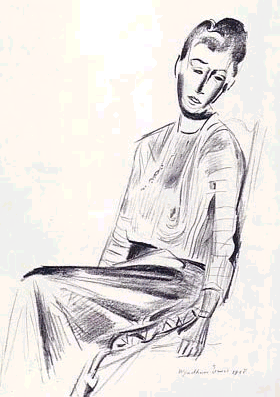
from Flashpoint
Yeah. I read a bit of this post by Johnathon Williams in my morning blog constitutional, and liked what I read of Lynette Roberts. I like discovering poets few think of any more (Keith Douglas anyone? Thanks to Ben Mazer for making me aware) or in some cases ever, so this is a great find for me, and I ordered her work.
Lynette Roberts, whose poetry was championed by T. S. Eliot and Robert Graves, might fairly be claimed to be our greatest female war poet, and her work constitutes one of the most imaginative poetic responses to modern war and the home front in the English language. Her first book, Poems, was published in 1944, with a blurb from Eliot, her editor at Faber:
"She has, first, an unusual gift for observation and evocation of scenery and place, whether it is in Wales or her native South America; second, a gift for verse construction, influenced by the Welsh tradition, which is evident in her freer verse as well as in stricter forms; and third, an original idiom and tone of speech. Graves called her “one of the few true poets now writing”; “her best is the best”, he declared, while Eliot praised her poems by that most Eliotic of criteria: that they communicated before they made sense. Dylan Thomas, with his usual waspishness about contemporaries, dismissed her as 'a curious girl, a poet, as they say, in her own right'."
When Roberts died in 1995, aged eighty-six, in a west Wales nursing home, her work had been out of print for nearly half a century, and has gone unregistered in histories of British poetry, even those dedicated to that much-maligned period, “the Forties”. “Oblivion” is too dramatic a word for what happened to her – footnotehood probably captures it better. She features in literary memoirs and correspondence as the wife of Keidrych Rhys, the flamboyant poet and editor of Wales magazine, in the letters of Dylan Thomas (who borrowed Vernon Watkins’s suit to be best man at their wedding), Alun Lewis, Robert Graves and others, and in occasional bibliographies of the period’s poetry. Though always an outsider, she cut a stylish figure on the London artistic scene, and was well connected not just with poets but with artists, photographers and designers. Alun Lewis, with whom she exchanged poems, was captivated, describing her as “a queer girl, [who] wears a red cloak and is unaccountable”. She moved in “New Romantic” and “Apocalypse” circles, encountering poets such as Henry Treece, Kathleen Raine and George Barker, while her husband’s close friendship with Dylan Thomas ensured she saw plenty of literary life’s underside. There are glamorous portraits of her by the photographer Ida Kar, less glamorous ones of her digging her garden in wartime by Douglas Glass (known for his weekly Sunday Times “Portrait Gallery”), and a pencil sketch of her, looking unusually serene, by Wyndham Lewis.
Now that I waggle around Google for a bit, I see there's a fair amount of info out there, though none of her poems. I shall have to fuck copyright over and type a few in here as soon as I can. Such wealth. . .
And then there's James Dickey, all over the place. Just look for him, if you care to. I've read him over and over and over, mostly just a few poems, but 'wild to be wreckage forever' is a line that sustains my perpetual adolescence, or did until I read the often-anthologized Sheep Child, after reading which I laughed until I shat my nice new green knickers and had to sally forth to teach undergraduate CW in my Bugs Bunny skivvies and work boots.

I have often longed to read this poem aloud--as a sort of intro to my work, maybe--at one of those ultra-serious no-one-breathes readings, introducing it by saying, in my best stentorian voice, "THIS, is a poem about the consequences (beat) of sheep-fucking.
There's more to Dickey than sexing up our animal friends though, beyond the Sheep Child and Cherrylog Road and that horrible Nimblewill Civil War thing, there's a decent novel and an early-middle period of generally stellar poems. Post-Deliverance, though, or from about 1972 or 73, it seems he became a parody of himself, though a vastly entertaining one, apparently, to judge by his speaking engagements. The exhaustive and fascinating biography The World as a Lie I also recommend highly.
Check out my dream office:

From The Creative Writing Guide
Thursday, November 5, 2009
Five New Poems at the Dead Mule

I would have said on the Mule, but I didn't want anyone to get the wrong idea. These are part of the last couple year's work. Poems.
Still radio silence until we get moved into the new house, where I will have an entire room full of books. My library, finally.
Subscribe to:
Posts (Atom)
Jason Ryberg
1)Heavy Doth Hang the Head that Wears the Hubcap Diamond Star Halo The Angel of Death is a crow pecking at some- thing in the gutter, and th...

-
 Probably everyone knows this poem and this book very well. Kinnell isn't exactly invisible in the poetry world. I loved this poem and th...
 -
 Line by line retranslation of Ashbery Waiting makes time democratic, you just said so Then a white horse ran by, repeatedly running back a...
 -
 Roadside Press $18.00 https://www.magicaljeep.com/product/prying/71 Limited Edition of 69 The three poets nesting cheek by jowl in this fetc...